

You're Rich on Paper, But Are You Retirement Ready?
You’ve done well. You’ve built a strong investment portfolio. You’ve hit — or even exceeded — the $1 million mark in investable assets.
On paper, you’re rich.
But being “rich on paper” doesn’t automatically mean you’re retirement‑ready.
As a Certified Financial Planner™ who’s worked with high‑net‑worth individuals, it is common to see a $2 million portfolio, a $1.5 million home, maybe even a rental property — yet, once income needs, taxes, healthcare costs, market risk, and longevity are modeled, weaknesses appear.
This post walks through what true retirement readiness looks like for someone with $1M+ in assets — and why net worth alone is the wrong benchmark.
1. The Illusion of Wealth: Why Net Worth Doesn’t Tell the Whole Story
When you see seven‑figure account balances and a high home value, it is natural to feel a sense of relief — even pride. Yet one of the biggest emotional risks in retirement planning is overconfidence: the feeling that “I must be fine; look at my statements,” even when cash flow, taxes, and risks have not truly been tested.
That gap between feeling secure and being secure is where regret often shows up. Retirees who discover late in the game that their “paper wealth” does not comfortably support their spending may find themselves forced to cut back, downsize abruptly, or return to work at a time when they expected freedom.
When you look at your brokerage account, home equity, and 401(k), the numbers may be impressive. But:
- Assets does not equal Income
- Liquidity does not equal Accessibility
- Value does not equal Utility
Consider:
- Your home may be worth $1.5 million, but unless you plan to sell, downsize, or tap it strategically, it is not directly funding your monthly lifestyle.
- Your $2 million portfolio may look strong, but if it is concentrated in stocks, it may not provide reliable income without exposing you to significant volatility.
- Rental real estate can create income, but if it requires ongoing management and decision‑making, it may feel more like a job than a retirement plan.
Then there are taxes. A traditional 401(k) or IRA balance has not yet been taxed; withdrawals are generally treated as ordinary income and can push you into higher brackets in retirement once distributions are required.[1]
Takeaway: “Rich on paper” is only useful if your assets can be converted into sustainable, tax‑aware income that supports your real life.
2. What Does “Retirement-Ready” Really Mean?
 Retirement readiness is not a single number; it is a complete, dynamic strategy that covers:
- Sustainable income that supports your desired lifestyle over 20–30+ years
- Tax efficiency across all your accounts, especially as required minimum distributions (RMDs) begin[1]
- Risk management for markets, inflation, health events, and longevity
- Legacy planning that reflects your values and intentions
Being truly retirement‑ready means you are financially secure, strategically positioned, and emotionally confident in your plan — not just comforted by your account balances.
3. Income Is the Outcome: Building Sustainable Retirement Income
A foundational question for pre‑retirees:
“If you stopped working today, where would next month’s income come from?”
Many portfolios are built for growth, not for steady withdrawals. A $2 million growth‑oriented portfolio may not safely support $120K per year of withdrawals if markets are volatile or if losses happen early in retirement.[2]
There is also a psychological shift required when you go from saving every month to spending down what you have built. Many otherwise confident savers struggle emotionally with this transition, experiencing anxiety or guilt when they start withdrawing from their portfolios, even when the numbers say it is sustainable.[3]
Behavioral finance research shows that people tend to anchor on familiar rules of thumb (“I’ll just take 4%”) or on what friends are doing, rather than on their own data and risk profile. That can lead to either overspending (because “everyone says 4% is safe”) or underspending (because of fear of outliving their money), both of which reduce quality of life in retirement.[3]
Designing clear income buckets and a written withdrawal strategy does more than optimize math; it gives you a psychological permission slip to enjoy your lifestyle, because you know where next year’s (and the next few years’) paychecks are coming from.
Three Buckets of Retirement Income Planning
Guaranteed Income
- Social Security (claiming age can permanently increase or decrease your monthly benefit).[4]
- Pensions, if available.
- Certain annuity structures designed to provide lifetime income, potentially helping hedge longevity risk.[2]
Semi‑Guaranteed or More Stable Income
- Bond ladders that are designed to provide scheduled cash flows.
- Dividend‑paying equities, with the understanding that dividends can change.
- Rental real estate, when appropriately managed and factored into the overall risk picture.
Market‑Based Withdrawals
- Systematic withdrawals from IRAs, 401(k)s, and taxable brokerage accounts.
- These strategies must account for market volatility and sequence‑of‑returns risk; research shows that fixed withdrawal rates (such as the popular “4% rule”) can be sensitive to poor returns early in retirement.[2]
Action step: Design your portfolio so that 3–5 years of planned withdrawals can come from relatively lower‑volatility assets such as cash equivalents and short‑term, high‑quality bonds. This buffer makes it easier to avoid selling stocks at depressed prices during market downturns.[2]
4. Taxes in Retirement: The Silent Wealth Killer
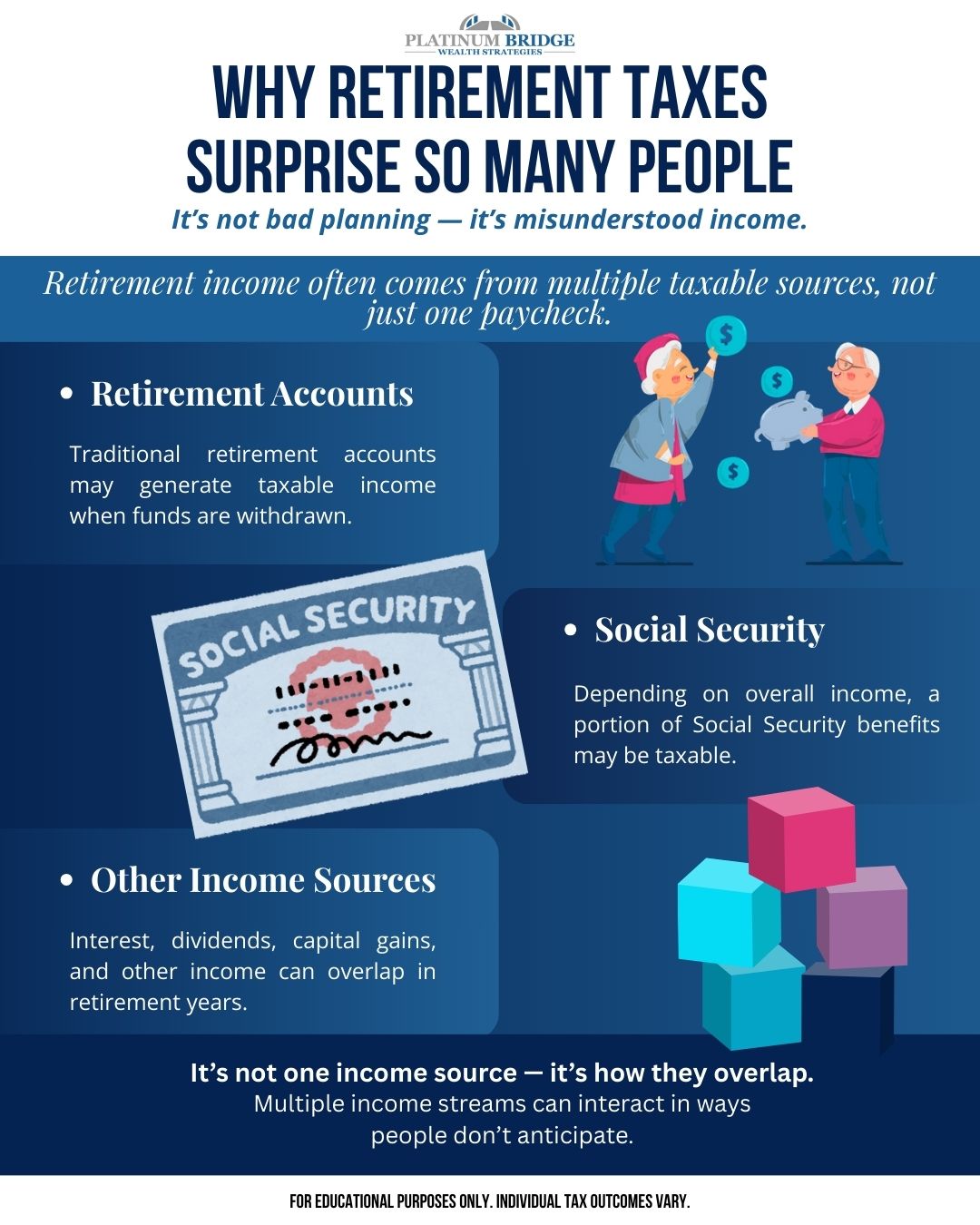 Many high‑net‑worth pre‑retirees assume their tax bill will drop once they retire. In practice, taxes can remain the same or rise.
Why?
- Required Minimum Distributions: RMDs from traditional IRAs and 401(k)s, which begin in the early 70s for many retirees, can substantially increase taxable income.[1]
- Social Security taxation: Up to 85% of Social Security benefits can be taxable when total income exceeds certain thresholds.[5]
- Other income: Capital gains, interest, and retirement account withdrawals can stack together with potential Medicare income‑related surcharges.
Strategies to Help Reduce Lifetime Taxes
- Roth conversions: Converting portions of traditional retirement accounts to Roth accounts in lower‑tax years before RMDs begin can reduce future forced taxable withdrawals.[1]
- Tax‑aware withdrawal sequencing: Coordinating withdrawals among taxable, tax‑deferred, and tax‑free accounts helps manage your overall tax burden across decades rather than just one year at a time.[2]
- Asset location: Placing more tax‑inefficient assets (like certain income‑generating investments) in tax‑deferred accounts and more tax‑efficient growth assets in taxable accounts can improve after‑tax outcomes over the long term.[2]
Action step: Have a professional run a multi‑decade tax projection (20–30 years) that includes RMDs, Social Security, and portfolio withdrawals instead of focusing only on next year’s tax return.
5. Sequence of Returns Risk: The Hidden Threat to “Paper Wealth”
Sequence‑of‑returns risk is not about the average return; it is about when good and bad returns occur. If two retirees earn the same long‑term average return, the one who experiences a market downturn early in retirement while withdrawing for income may see far worse outcomes than someone whose downturn happens much later.[2]
Market volatility is not just a financial event; it is an emotional event. Watching account values fall early in retirement can trigger loss aversion — the tendency to feel losses more intensely than gains — which can push investors to sell low, lock in losses, or abandon a plan at exactly the wrong time.[6]
A structured approach to sequence risk (cash buffers, income floors, and clear rules for when to adjust spending) is not only about protecting the portfolio; it is about protecting you from your own worst impulses under stress. In other words, smart structure helps you avoid making permanent decisions based on temporary emotions.
Ways to Help Manage Sequence Risk
- Maintain 3–5 years of planned withdrawals in cash and high‑quality short‑term fixed income, so you can avoid selling growth assets in a downturn.[2]
- Use bond ladders or similar structures to pre‑fund near‑term spending.
- Consider an “income floor” approach in which essential expenses are covered by guaranteed sources like Social Security, pensions, and certain annuities, while market‑based assets fund discretionary goals.[2]
Action step: Request a retirement income analysis or Monte Carlo simulation that explicitly models poor market sequences in the first 10 years of retirement, not just average returns.[2]
6. Inflation and Healthcare: The Twin Threats to Longevity Planning
 With longer life expectancies, many people will spend 25–30 years or more in retirement, which magnifies the impact of both inflation and health costs.[7]
Health‑care shocks are not just line items in a plan; they are moments of real stress that can force difficult choices if you are unprepared — choices between care options, where to live, and how much support you can offer family.
Healthcare Costs in Retirement
Health care is one of the most commonly underestimated expenses:
- Recent estimates indicate that a healthy 65‑year‑old retiring in 2025 could spend between roughly $275,000 and $313,000 on healthcare over retirement, depending on sex and coverage assumptions.[7]
- These projections generally exclude long‑term care, which can significantly increase lifetime costs.[7]
What You Can Do Now
- Build healthcare inflation assumptions into your plan, recognizing that health costs have historically grown faster than general inflation.[7]
- Explore long‑term care strategies, including insurance, hybrid policies, or dedicated savings.
- Use Health Savings Accounts (HSAs), if you are eligible, as a tax‑advantaged way to save and invest for qualified medical expenses in retirement.
Action step: Treat healthcare and long‑term care as their own line items in your retirement plan instead of assuming Medicare alone will cover everything.
7. Lifestyle, Identity, and Legacy: The Human Side of the Plan
 Retirement is not just a math exercise; it is a major life transition. Your financial plan should support the life you want to live.
Many new retirees report a mix of excitement and loss as they navigate changes in routine, purpose, and identity — moving from “I am my work” to “Who am I now?” Without a clear vision, it is easy to drift, feel less relevant, or struggle with the sudden open space in your calendar.[8]
Connecting your financial strategies to a clear vision of who you want to be in this next chapter — mentor, grandparent, traveler, volunteer, community leader — helps reduce that emotional drift and uncertainty. When your spending, giving, and investing are anchored to roles and values that matter to you, the numbers on the page become a tool for meaning, not just a scorecard.[8]
Reflect on questions like:
- What does your ideal day or week in retirement look like?
- Which experiences or goals are on your “someday” list that you want to prioritize in the next 5–10 years?
- What legacy — financial, relational, or charitable — do you want to leave?
Retirement readiness is not only about avoiding the risk of running out of money. It is about using your wealth with intention: funding education for family, supporting causes you care about, traveling while you are healthy enough to enjoy it, and investing time in relationships and passion projects.
Action step: Clarify your top priorities for purpose, people, and experiences in retirement, then align your spending, saving, investing, and giving decisions with those priorities.
8. The Retirement Readiness Checklist for the $2M+ Investor
Use this checklist as a quick self‑assessment:
- ✅ Do you have 20–30 years of projected income mapped out, including inflation and healthcare costs?[7]
- ✅ Do you have a written withdrawal strategy, rather than relying solely on a rule of thumb like “4% per year”?[2]
- ✅ Have you specifically addressed sequence‑of‑returns risk and built a buffer for market volatility?[2]
- ✅ Do you understand your future tax liabilities, including RMDs and potential taxation of Social Security benefits?[5]
- ✅ Is your healthcare and long‑term care plan realistic, with cost assumptions grounded in current data?[7]
- ✅ Are your estate planning documents up to date and aligned with your wishes?
- ✅ Do you know what you’re retiring to, not just what you’re retiring from?
If any of these boxes remain unchecked, you may have wealth — but not true readiness.
From Numbers to Peace of Mind
Having $2 million or more puts you in a strong position, but unmanaged “paper wealth” can create a false sense of security. Retirement success depends less on your account balance today and more on how intentionally you convert that balance into sustainable, tax‑smart income aligned with your life and legacy goals.[2]
At its core, this kind of planning is about emotional outcomes: less anxiety about markets, fewer surprises around taxes and healthcare, and more confidence that you can say “yes” to the people and experiences that matter most. Surveys of retirees consistently find that those who engage in comprehensive planning report higher levels of retirement satisfaction and lower stress than those who rely on rules of thumb or vague assumptions.[9]
Your “why” for doing this work is not just to optimize withdrawal rates or minimize taxes. Your why is to wake up in retirement feeling secure, purposeful, and free to live the life you have spent decades building toward — without constantly worrying that one bad market year or one big bill will unravel it.[9]
If you’re within about five years of retirement — or already retired and looking for more clarity — schedule a free, no‑obligation consultation to stress‑test your plan, uncover hidden risks, and start turning paper wealth into a retirement you can truly enjoy.[9]
SOURCES
- https://www.cbo.gov/budget-options/60913
- https://papers.ssrn.com/sol3/Delivery.cfm/SSRN_ID3501673_code388906.pdf?abstractid=3501673&mirid=1
- https://www.ifebp.org/resources---news/toolkits/financial-education-retirement-security-us/behavioral-economics-retirement-security
- https://www.ssa.gov/benefits/retirement/planner/agereduction.html
- https://www.ssa.gov/pubs/EN-05-10035.pdf
- https://allianceam.com/safety/behavioral-finance-and-retirement-planning-overcome-psychological-biases
- https://www.milliman.com/en/insight/retiree-health-cost-index-2025
- https://retirees.uw.edu/resources/retirement-transitions/the-retirement-process-a-psychological-and-emotional-journey/
- https://www.stablevalue.org/survey-shows-strong-link-between-planning-and-retirement-readiness/
- https://ppl-ai-file-upload.s3.amazonaws.com/web/direct-files/attachments/55684834/76fb64b1-95b5-4288-a5a1-aef63c712285/You-re-Rich-on-Paper-But-Are-You-Retirement-Ready_.web.pdf
Investment advisory services offered through Osaic Advisory Services, LLC (Osaic Advisory), a registered investment advisor. Osaic Advisory is separately owned, and other entities and/or marketing names, products, or services referenced here are independent of Osaic Advisory.